How RDA Builds and Manages Your AI Workforce
An AI Workforce should make running a business easier—not give you another complicated system to manage. RDA combines AI-powered workflows, practical work processes and human supervision so useful work gets done with the right level of control.
Businesses rarely need more technology for its own sake. They need help answering customers, following up leads, keeping records updated, preparing reports, managing schedules and completing daily administrative work.
AI can take on much of this repeatable work, but businesses still need confidence that sensitive decisions, uncertain cases and important exceptions will be handled properly.
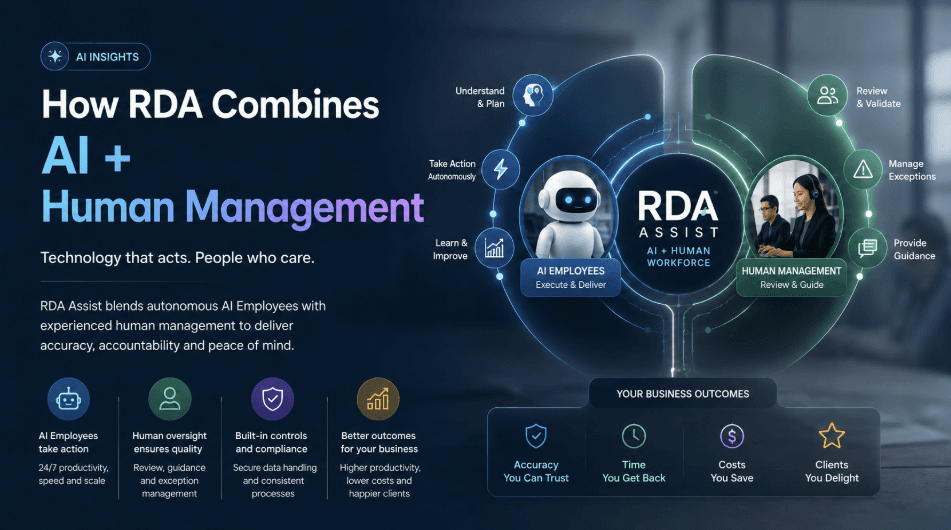
RDA solves both sides of the problem. We prepare an AI Workforce for the work you need done, then give you the flexibility to have it fully managed by RDA, co-managed with the RDA Assist Team, or managed by your own team.
What “AI Workforce as a Service” means
AI Workforce as a Service gives a business access to AI-powered workflows, connected work processes and optional human management as one practical operating model.
- AI-powered workflows are assigned clear jobs, responsibilities and expected outcomes
- They work with approved business information and connected work apps
- Important or sensitive actions can require human review or approval
- Work, exceptions and outcomes remain visible and accountable
- The workforce is reviewed and improved as the business changes
How RDA builds your AI Workforce in 4 steps
1. Tell us what work you need help with
We learn about your business, the work taking up your time and the outcomes you need. We focus on practical jobs such as customer service, administration, social media, real estate support, data operations, bookkeeping support, e-commerce and executive support.
2. We prepare the right AI Workforce
RDA defines the AI-powered workflows, job instructions, approved knowledge, work apps, limits and escalation rules needed for your business. The technical complexity stays behind the scenes.
3. Choose how your workforce is managed
Choose Fully Managed by RDA, Co-Managed with the RDA Assist Team, or Managed by Your Team. You can change the management model as your business and internal capability grow.
4. Start working, review and improve
We launch with clear controls, review early results and improve the workforce over time. Routine work can move faster, while sensitive or uncertain cases receive the right human attention.
Eight AI Workforce Solutions available from RDA
RDA can prepare and manage an AI Workforce around the services businesses already need:
AI Administrative Workforce:
inboxes, scheduling, documents, reporting, data entry and daily coordination.
AI Customer Service Workforce:
routine enquiries, customer updates, follow-ups and escalation of sensitive cases.
AI Real Estate Workforce:
property listings, lead follow-ups, appointments, client coordination and transaction administration.
AI Healthcare Admin Workforce:
scheduling, inboxes, records, coordination and supervised daily administration.
AI E-Commerce Workforce:
product listings, customer messages, order follow-ups, inventory updates and store administration.
AI Data Operations Workforce:
spreadsheets, CRM records, databases, reports and accuracy checks.
AI Bookkeeping Support Workforce:
invoices, receipts, expenses, transaction categorisation and reconciliation support.
AI Executive Support Workforce:
scheduling, inboxes, meeting preparation, research, reporting and stakeholder coordination.
Why human management remains important
AI-powered workflows can handle routine, repeatable work quickly, but not every situation should be automated without review. Human managers provide judgment, empathy, accountability and exception handling. With RDA, that human layer can come from your team, the RDA Assist Team, or both.
“AI handles the repeatable work. People stay focused on judgment, relationships and the decisions that matter.”
Start with one business need
You do not need to redesign your whole company. Start with one area that consumes time or delays customers, prove the value, and then grow your AI Workforce as confidence increases.
Build your first AI Workforce
Tell us what your business needs and we can build it.
RDA will recommend a practical AI Workforce and the management model that fits your business today.